Understanding Retinal Health: Age‑Related Changes
AMD: Age-related Macular Degeneration
Age-related macular degeneration (AMD) is a chronic, progressive neurodegenerative disease of the central retina and a leading cause of irreversible vision loss among individuals aged ≥50 years in developed countries1,2
normal
Scotoma
Metamorphopsia
Around 200 millions people are affected
An increase up to around 300 millions by 2040 has been estimated1
RISK FACTORS3
ADVANCING AGE
OBESITY
genetics family story
high fat diet
smoking
HEART DISEASE
UV/BLUE light exposure
high blood pressure
lighter eye color
nutrient/vitamin deficiency
ADVANCING AGE
OBESITY
GENETICS FAMILY STORY
HIGH FAT DIET
SMOKING
HEART DISEASE
UV/BLUE LIGHT EXPOSURE
HIGH BLOOD PRESSURE
LIGHTER EYE COLOR
NUTRIENT/VITAMIN DEFICIENCY
AMD: Age-related Macular Degeneration 4,5
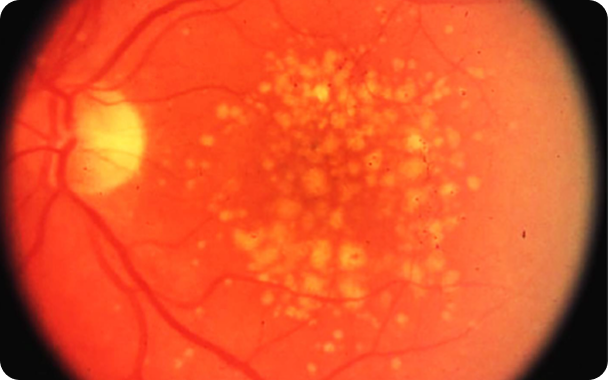
DRUSEN ONSET
Fatty deposits accumulate in the macula years before drusen are visible, making them the tip of the iceberg in AMD pathology.
They cause oxidative stress and inflammation and block absorption of nutrients, such as vitamin A, necessary for normal cell function, especially the photoreceptors.
AMD STAGES11
AREDS CATEGORY
DESCRIPTION
1. No amd
No or a few small (<63µ in diameter) drusen
2. Early AMD
Many small drusen or a few intermediate-sized (63–124µ in diameter) drusen, or macular pigmentary changes
3. Intermediate AMD
Extensive intermediate drusen or at least one large (≥125µ) drusen, or geographic atrophy not involving the foveal center
4. Advanced AMD
-
Geographic atrophy involving the foveal center
(atrophic or dry AMD) - Choroidal neovascularisation (wet AMD)
- Evidence of neovascular maculopathy (subretinal haemorrhage, serous retinal or retinal pigment epithelium detachments, lipid exudates, or fibrovascular scar)
AMD & TREATMENT3
At present, there is no definitive cure for age-related macular degeneration. Disease management therefore focuses on slowing disease progression and reducing the risk of advancement to late-stage forms, which are associated with a significant impact on visual function and quality of life.
Early identification, education, regular monitoring, and timely intervention play a key role in preserving vision for as long as possible.
Patients from stage 0 disease should be counseled to:
AREDS STUDIES6,7
The Age-Related Eye Disease Study (AREDS) and AREDS2 were landmark clinical trials conducted by the U.S. National Eye Institute to evaluate strategies aimed at slowing the progression of age-related macular degeneration (AMD).
Objective and Results
The studies investigated whether specific nutritional supplementation could reduce the risk of progression to advanced AMD in patients at moderate to high risk.
Results showed that the AREDS formulation significantly lowered the likelihood of disease progression to late stages. AREDS2 further optimized the formulation while maintaining its protective effect.
While these supplements do not cure AMD or restore vision, the AREDS studies demonstrated their role in supporting the management of the disease by delaying progression, contributing to the preservation of visual function.
DIABETIC RETINOPATHY8,9
Diabetic retinopathy (DR) is the most common microvascular complication of diabetes
Diabetes affects 537 million people worldwide
1 out of 5 diabetic patients can
develop DR
the onset and progression of diabetic retinopathy are strongly related to both the duration of diabetes and to the level of glycemic control
diabetic retinopathy: THE PROBLEM9,10
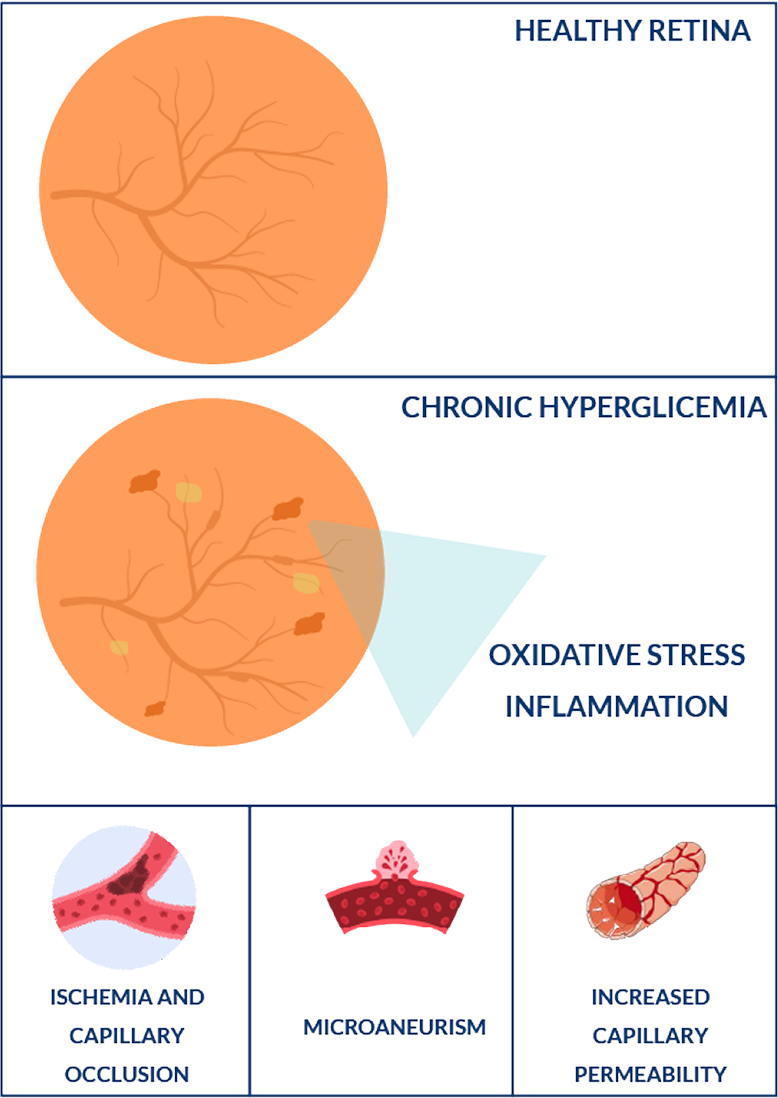
DR starts as non-proliferative DR (NPDR) and later may progress to proliferative DR (PDR) with new vessels growing toward the vitreous cavity from the retina. Vitreous hemorrhage and tractional retinal detachment often happen in the later stages of PDR.
Microcirculation diseases have oxidative and inflammatory processes as a common element, characterized by the occurrence of edema at capillary region.
Diabetic macular edema (DME) is another severe manifestation and can arise at any stage of DR.
Based on the impact on vision, mild and moderate NPDR are categorized as non-vision-threatening DR, while vision-threatening DR (VTDR) includes severe NPDR, PDR, and DME.
TREATMENTS to VASOPROTECT &
to REDUCE NEW
BLOOD VESSELS9,10,12
For individuals with high-risk of proliferative DR
For most eyes with diabetic macular edema and for individuals with proliferative DR
For eyes with persistent diabetic macular edema despite previous anti–vascular endothelial growth factor therapy or
eyes that are not candidates for this first-line approach.
Vitreous hemorrhage and tractional retinal detachment.
Antioxidant and anti-inflammatory properties of a variety of nutraceuticals may inhibit the early diabetes-driven molecular mechanisms that induce DR, reducing intraocular changes that lead to both the neural and vascular damage typical of DR.
Advancing Eye Care Through a Complete Product Portfolio
Evidence-based solutions designed to support clinical excellence
References:
1. Wong WL, et al., Global prevalence of age-related macular degeneration and disease burden projection for 2020 and 2040: a systematic review and meta-analysis. Lancet Glob Health. 2014 Feb;2(2):e106-16
2. Chakravarthy & Peto Current Perspective on Age-Related Macular Degeneration. JAMA. 2020 Aug 25;324(8):794-795.
3. Age-related macular degeneration: diagnosis and management. NICE Guideline, No. 82. London: National Institute for Health and Care Excellence (NICE); 2018.
4. Singh, M., Negi, R., Alka, Vinayagam, R., Kang, S. G., & Shukla, P. (2024). Age-Related Macular Degeneration (AMD): Pathophysiology, Drug Targeting Approaches, and Recent Developments in Nanotherapeutics. Medicina, 60(10), 1647.
5. Curcio CA. Antecedentsofsoft drusen, the specific deposits of age-relatedmacular degeneration, in the biology of human macula. Invest OphthalmolVis Sci.2018;59:AMD182–AMD194
6. Age-Related Eye Disease Study Research Group. The Age-Related Eye Disease Study (AREDS): design implications. AREDS report no. 1. Control Clin Trials. 1999 Dec;20(6):573-600;
7. Age-Related Eye Disease Study 2 Research Group. Lutein + zeaxanthin and omega-3 fatty acids for age-related macular degeneration: the Age-Related Eye Disease Study 2 (AREDS2) randomized clinical trial. JAMA. 2013 May 15;309(19):2005-15.
8. IDF Diabetes Atlas, 10th edition 2021;
9. Diabetes Care 2023;46(Suppl. 1):S203–S215;
10. Scuderi, Cicero «Nutraceutical approach to diabetic retinopathy: established data and scientific novelties». Pharmanutrition and Functional Foods, 2022
11. Agrón E, Domalpally A, Chen Q, Lu Z, Chew EY, Keenan TDL: An Updated Simplified Severity Scale for Age-Related Macular Degeneration Incorporating Reticular Pseudodrusen: Age-Related Eye Disease Study Report Number 42, Ophthalmology, 131 (10), 2024, 1164-1174
12. Rossino MG, Casini G. Nutraceuticals for the Treatment of Diabetic Retinopathy. Nutrients. 2019 Apr 2;11(4):771. doi: 10.3390/nu11040771. PMID: 30987058; PMCID: PMC6520779.)